

2026 Power Index Updates
What’s New and What’s Changed
Every July, recruits and parents hold their breath a little.
That’s when we publish our first recruit rankings for the previous year’s freshman class and update the base times used to Power Indexes (PI’s) for rising juniors and seniors.
If you’re in the Class of 2027 or 2028, your PI is about to change. Maybe a little, maybe more. Either way, we want to explain exactly what’s happening and why.
Nearly Twenty Years of Trust
Before we get into the numbers, let’s zoom out for a second.
Swimcloud has been ranking swim recruits for nearly two decades. Today, close to 85% of college programs at every level use our Power Index as part of their recruiting process. That trust is something we take seriously. It also shapes every decision we make when it comes to updating our formula.
It’s why, when we faced a real methodological problem this year, our goal was to adapt carefully and preserve the scale that fans and coaches have come to rely on (and to be transparent about what changed and why)
The Formula Hasn’t Changed — But the Benchmarks Have
Last year was a big one for us. We simplified the formula, made it easier to understand, and added the 50s of stroke as eligible events. None of that is changing.
If you’re new here, here’s the quick version of how a Power Index works:
Power Points measure how your best time in an event compares to a college-level benchmark:
Power Points = (((Your Time ÷ Base Time)³) − 1) × 100 + 1
Your Power Index is then a weighted average of your top four events:
Event #1 and #2: 100% weight each
Event #3: 25% weight
Event #4: 5% weight (primarily for tiebreaking)
If you don’t have a third or fourth event, those slots are assigned a default of 100 Power Points — so adding verified swims can only help your score.
What is changing this year are the base times — the benchmarks your swims are measured against. And this year, we had to rethink how we calculate them.
Why We Had to Change our Approach
Here's the short version of a complicated situation.
In the past, our base times were set around the slowest qualifying time at the NCAA Division I Championship. It was simple: to get into the meet, you had to hit a specific time, and we used that cutoff as our benchmark. Clean, transparent, easy to explain.
The the NCAA shook things up by allowing the champion of each conference can automatically qualify if they hit a standard, even if they were SLOWER than another swimmer. [SwimSwam explains it well here.] That meant there was no longer a clean cut time.
Since the NCAA changed, we had to change with it.
A New Methodology: Pegged to the Championship Field
Rather than base our benchmarks on who qualified, we now base them on what swimmers actually swam at the meet.
Specifically, we look at the times posted by swimmers in the preliminary heats. Then we averaged that across the past three championship meets. That three-year average becomes the new base time.
This approach has several advantages:
It doesn’t matter how a swimmer qualified — time qualifier or conference champion, what counts is what they swam at the meet
It’s stable and transparent — anyone can look up the NCAA results and verify the numbers themselves
It smooths out year-to-year variation — by averaging three years, a single unusual year has limited impact on the base time
The place we target within the championship field varies by event group, reflecting the availability of points in a given distance.
Event Group
50’s and 100’s - 30th Place (Women) - 37th Place (Men)
200’s - 27th Place (Women) - 32nd Place (Men)
400+ - 24th Place (Men and Women)
Why different places for different event groups? Sprint and relay events account for more than half the points at championship meets so setting a slightly more accessible standard for sprinters reflects how coaches actually build a roster.
Why different places for men and women? The honest truth is that high school boys are further from their college potential than high school girls of the same age. Boys develop later. Between senior year of high school and freshman year of college, male swimmers tend to improve more dramatically — in strength, in power, in technique — than their female counterparts. A boy swimming a 46.5 in the 100 Back as a junior is likely to look very different by the time he’s a college sophomore. If you want to see how much they improve login and click on the “How I Fit” button.
Consistency Matters
One reason we’re careful about how much we move the scale year over year is because of coaches. A coach has an instinct for what a 20-point swimmer looks like versus a 35-point swimmer. They know which scores fit their program and which ones don’t. Many go further to track a recruit’s PI over multiple years specifically to see who is making the biggest gains. A 28-point junior who improved from 40 as a sophomore tells a very different story than one who has been sitting at 28 for two years.
If we moved the scale dramatically, even in a direction that seemed analytically justified, we’d be asking hundreds of programs to recalibrate from scratch. That’s not a change we take lightly, and it’s not one we’d make without a very good reason.
This year, we had a reason — the NCAA’s qualifying changes forced our hand on methodology. But our goal throughout was to adapt the how while preserving the what. The numbers coaches see this July should feel familiar, even if the engine running underneath them is new.
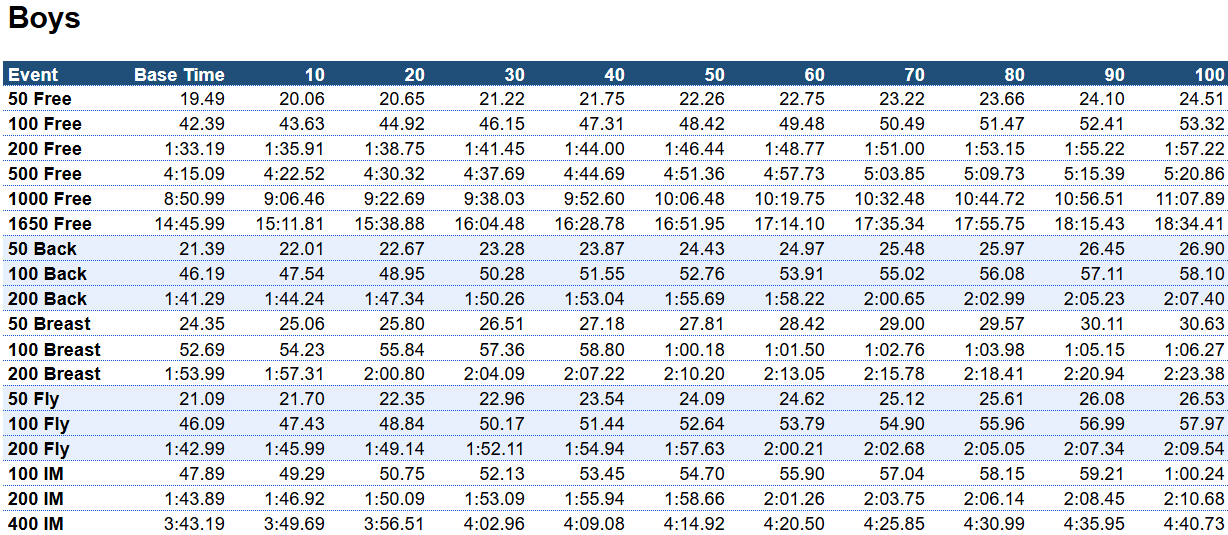
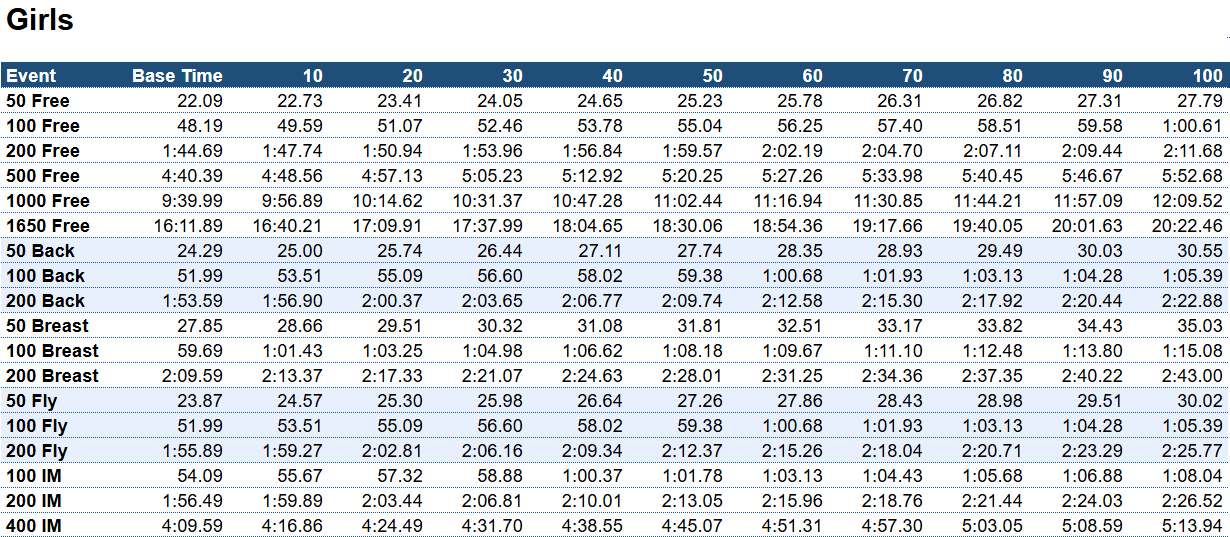
The 2026-27 Base Times
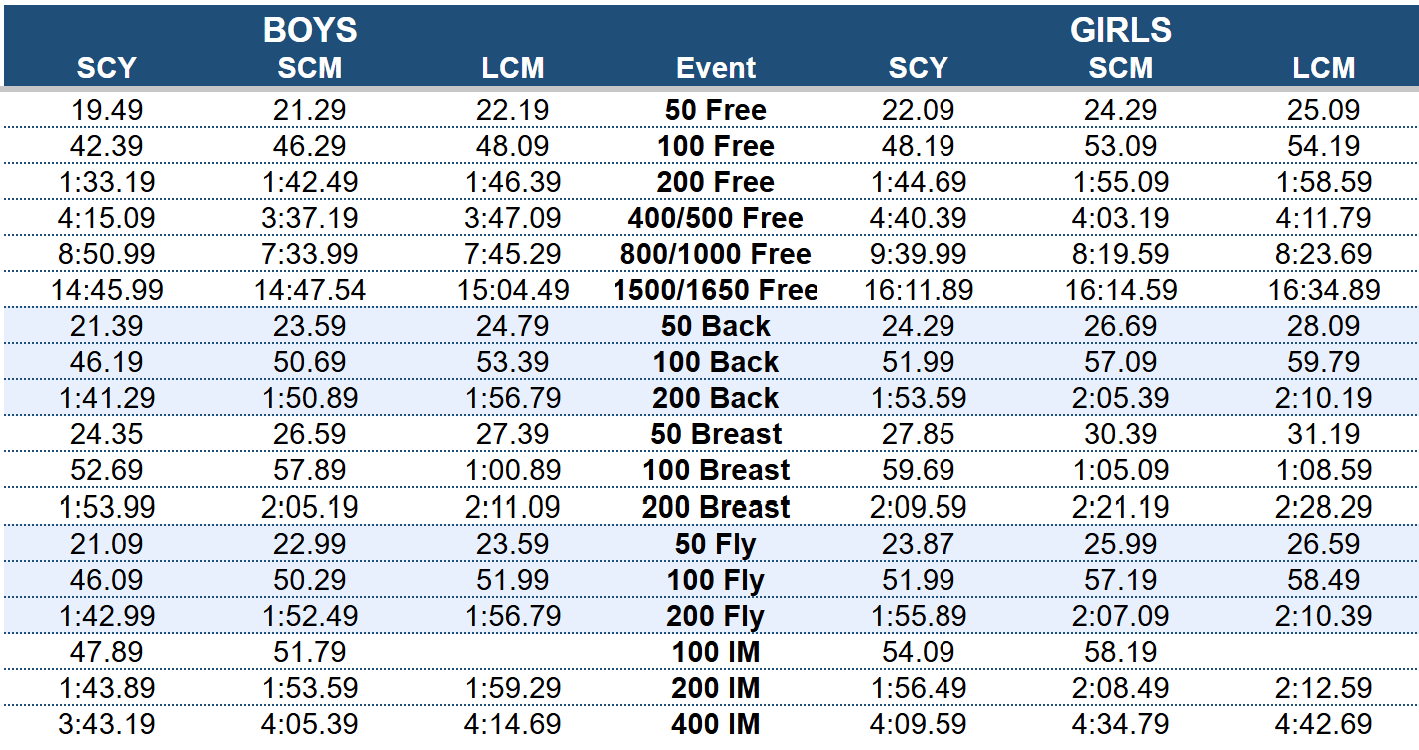
Annual Base Time Adjustments
For most events, the new methodology produces base times that are very close to last year’s — typically within a few tenths of a second.
Women’s events are largely stable. Sprints and 200s tightened slightly — typically 0.10 to 0.30 seconds — and distance events are essentially unchanged.
Men’s events tell a slightly more varied story. Sprint and stroke events tighten modestly. The 200 Free and 400 IM see more meaningful moves reflecting genuine improvement among the men’s field. The 500 Free eases slightly, which reflects a recalibration: last year’s distance base for men was set aggressively ahead of where the actual field was performing, and we’re letting it drift back toward reality. The 400 IM tightens more significantly, reflecting a genuine and consistent improvement trend across all three years of data.
Exceptions: When We Override the Formula
Sometimes a single year's data is just off — usually because an automatic qualifier with a slower time ended up at exactly the place in the results we were targeting. When that happens, rather than let one bad data point push a base time in the wrong direction, we hold the prior year's number and revisit it next year with fresh data.
This year that happened in four events: Women's 200 IM, Women's 1650 Free, Men's 200 Breast, and Men's 1650 Free. In each case, the 2026 data was distorted enough that using it would have produced a change out of step with where those events are actually heading.
A Note on the 50s of Stroke
Last year we added the 50 Back, 50 Breast, and 50 Fly as eligible events. That's not changing. Base times for those events have been nudged slightly this year — kept proportionally harder to hit than the corresponding 100s, by design. We want these events to reward genuine sprint specialists, not create a shortcut.
What This Means for You
For most swimmers, the honest answer is: not much. A few tenths of a second in a base time moves your PI by a fraction of a point. If your times have improved, your PI will almost certainly improve too — and any base time change will be a rounding error by comparison.
The swimmers who feel it most are those right on the edge — where a tenth or two in the base time actually matters. If your score moved in a direction that surprised you, look at which base times changed for your best events. The answer is usually right there.
The Bottom Line
Coaching recruiting is hard. It involves projecting what a 16-year-old will look like as a 20-year-old, across thousands of athletes, with limited time and imperfect information. Our job is to make that process a little less guesswork — with numbers that are transparent, consistent, and grounded in real data.
Will your PI change this year? Probably a little. Will it change dramatically? For most of you, no — and that’s intentional.
And if you want a better PI next year? You already know the answer. Swim faster, compete in more events, and keep showing up. The rest takes care of itself.
Frequently Asked Questions
Why did my Power Index change?
Every July we update base times to reflect the current standard of college swimming. Even if your times haven’t changed, the benchmarks they’re measured against may have shifted slightly. In most cases the change is small — a few tenths of a second in the base time translates to a fraction of a point in your PI.
Why did you change the way you calculate base times?
The NCAA’s new automatic qualification system for conference champions meant that the qualifying time cutoff — which we previously used as our benchmark — is no longer reliable. Our new approach uses actual championship meet times averaged across three years, which is more transparent and completely independent of the qualifying structure.
Will this happen every year now?
Yes — and that's a feature, not a bug. Each summer we update the data, rerun the same calculation, and adjust the benchmarks. The methodology stays fixed. Only the numbers change.
Why are the base times different for men and women?
Boys develop later than girls relative to their college potential. A given high school time means something different for a 17-year-old boy than for a 17-year-old girl. We account for that so coaches get an accurate picture of each recruit's upside — not just where they are today.
Why are some events unchanged from last year?
In four events, the 2026 championship data was distorted enough that using it would have produced a misleading result. We held those base times at last year's level and will revisit next year with updated data.
My PI got worse even though my times improved. How?
If the base time for your best event got faster, the bar is higher — so the same improvement earns slightly fewer points than it would have last year. This is how the system is supposed to work: as college swimming gets faster, the benchmarks rise too. A real improvement in your times will always matter more than any base time adjustment.
Does the club team I swim for affect my Power Index or my recruiting chances?
Never. Swimcloud evaluates every swimmer on the same terms: your verified times from official competition. We don’t factor in club affiliation, coaching reputation, or program size. A swimmer from a small club with fast times will be ranked exactly where their times place them. That’s the only way to build a system coaches — and swimmers — can actually trust.